Pistachios on the Move: Examining the Impact of Climate Change on Cash Crops in California
Abstract
Climate change is expected to have a significant impact on land use movement throughout the state of California. Land use movement refers to the shift or change in the way that land is being utilized. Changes in land use can be caused by a variety of factors including economic, demographic, or environmental changes. This research paper will examine how climate change is affecting the land use movement of cash crops in California; specifically analyzing the movement of pistachios. Rising temperatures and changing precipitation patterns are likely to shift the geographic range of suitable growing conditions for pistachios, leading to changes in ideal environments in which pistachio crops can be grown. This study utilizes Geographic Information Systems (GIS), which can be used to track and map the changes in land use, as well as predict future movements of pistachio crops by using a variety of Global Climate Models (GCMs). This study also utilizes maximum entropy (Max Ent); Max Ent is a supervised machine learning model used for creating land-use or land-cover classifications or predictions. Using the data collected from Max Ent we can calculate predicted land movements. We can expect these predicted movements to depict which regions will be most suitable for pistachio crops. The projections obtained by the study allow us to provide farmers, policymakers, and landowners with the necessary information to make informed decisions about the cultivation of pistachios in response to a changing climate.
Keywords: Climate Change, Pistachios, Maximum Entropy, California
1. Introduction
1.1 Impacts of Climate Change
Climate change is significantly impacting the distribution of land uses across California, with rising temperatures and changing precipitation patterns which are leading to shifts in the types of crops that can be grown in certain regions. One crop that is particularly vulnerable to these changes is pistachios, which are a major cash crop in California and are sensitive to changes in temperature and water availability.
The California Agricultural Statistics Review (2019-2020) found that pistachios were the third most valuable nut-based crop, with a production value of over 3 billion USD. California produces a large percentage of the world’s pistachios, second only to Iran which produces roughly fifty percent. Unfortunately, the future of this multibillion-dollar industry in California is uncertain due to the potential impacts of climate change on environmental conditions and water availability.
1.2. Vulnerability of Pistachio Crops
Through the examination of a variety of papers on pistachio crops, we have found that pistachios are not tolerant to extreme heat. Thus exposure to high-temperature events during the growing season can cause significant losses in yield (Derya, et al 2020). Increasing temperatures caused by a shift in climate could result in a significant decline in pistachio production. If there was a decline in pistachio production, we would most likely require a massive agricultural transition in order to meet the high demand.
Through our research, we also found that farmland growing pistachios, as well as California’s other specialty crops, are projected to experience temperature increases that exceed their optimal growing ranges by 2050 (Kerr, et al 2017). Since there is a direct correlation between pistachio yields decreasing and increasing temperature, we can infer that the pistachio yields will continue to decline in the future. If adaptation measures are not implemented, the future of specialty crops in California may be in jeopardy.
2. Methods
2.1 GIS
This study utilizes Geographic Information Systems (GIS), which is often defined as a collection of computer hardware, software, geographic data, and trained personnel that are able to manipulate, update, analyze, and display all forms of geographic data. The term GIS is becoming redefined in recent years, due to the wide range of topics and information that can be analyzed. The newly developing definition of GIS is Geographic Information Science; this is because GIS has opened a new door for analyzing data and contributing to scientific studies. Individuals trained to use GIS software are able to utilize geographical data in order to solve important questions about a wide range of topics. The methods of this study will include a variety of GIS tools, including Max Ent.
2.2 Max Ent
This study also utilizes maximum entropy (Max Ent); Max Ent is a supervised machine learning model used for creating land-use or land-cover classifications or predictions. We are analyzing raster data of California’s current distribution of land uses to better understand where pistachios are presently being grown. The raster data was converted into rarified points, using the “spatially rarify occurrence data” tool in ArcMap, to better identify locations where pistachio plants are being grown. Spatially rarified points allow you to reduce the input size by creating occurrence points wherever there are pistachios present. The tool removes repeating data points in order to speed up processing times.
We use the spatially rarefied points, Global Climate models, and Maximum Entropy learning models to perform presence-only predictions. The presence-only prediction tool allows for an input of “explanatory rasters” which is used to upload the historical bioclimatic data. The historical climatic data provide a baseline for what the climate has been in the past. There is also an input for “explanatory rasters matching” which is used to upload one of the eight global climate projection models which will provide insight into California’s future climate.
To reduce the impact of sampling bias, we also utilized the spatial thinning option. Spatial thinning does this by removing unnecessary information while still retaining the greatest amount of information that is useful for the topic. We set our spatial thinning distance for 5000 meters to allow for some of the overlapping presence points to be removed.
To obtain an average of the projections of the different climate models, we utilize the fuzzy overlay tool. We input all the climate model projections for 2041 in order to get the average for that time period. We then input all the climate model projections for 2081 to obtain averages for the end of the century. The fuzzy overlay provides an output that contains the most likely areas that will be sustainable for future crops.
2.3 Global Climate Models
For this study, we will be using GIS to track and map the changes in land use as well as predict future movements of pistachio crops by using Global Climate Models. These climate models provide both a historical record of the climate that has occurred throughout California’s past as well as providing predicted climate change patterns that are expected to occur over the next 80 years.
Some unique elements of the global climate models used in this study include elevation, slope, and aspect. We believe these factors were important to include because greater elevations have a direct correlation to surface temperature; aspect influences a variety of factors including wind patterns, solar radiation, and atmospheric pressure; and slope determines the amount of vegetation that can be grown in the given area. These elements allow us to have a more accurate prediction on where the most suitable locations for pistachio crops will be.
2.4 Python
The majority of this study has been conducted using Python scripting. Python is the coding language primarily used for ESRI products such as ArcGIS Pro and ArcMap which are both used in this study. We use python in order to streamline the workflow, keep our data organized, and run complex spatial tools. In this study, we use python scripting to input a variety of different climate models as well as land use data to perform our Max Ent predictions.
3. Results
This study is still undergoing the final stages of the research. We have been able to identify what regions are expected to experience expansion and contraction. Our current results show the most contraction throughout Southern California and the central valley by 2061. By 2100 the central valley is expected to continue to contract but there are some small areas in Southern California that are actually expected to see some expansion. It seems that the areas in Southern California that will become unsuitable by 2061 will become suitable again by 2100; the amount of area is significantly less but the return of pistachios to this region is promising. Another region that is expected to experience some expansion as well is Northern California. The expansion isn’t extreme but, we see about six new locations that will become marginally suitable for pistachios. We can also see a significant decrease in pistachio crops being grown throughout the Sierra Nevada region; by 2100, the vast majority of pistachios will have left the region. The most significant contraction is experienced throughout the central valley where the majority of suitable farmland will be greatly reduced.
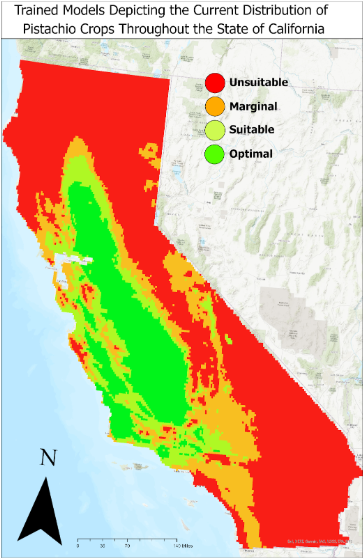
Figure 1. Displays the current distribution of pistachio crops in California. This map is the product of averaging the trained models together. The trained models represent the current pistachio distribution throughout the state. All the trained models were very close when compared because they are all using the same current distribution data. It would be safe to say that this map accurately depicts the current distribution of pistachio crops in California. We can use this map as a baseline reference for future expansion and contraction.
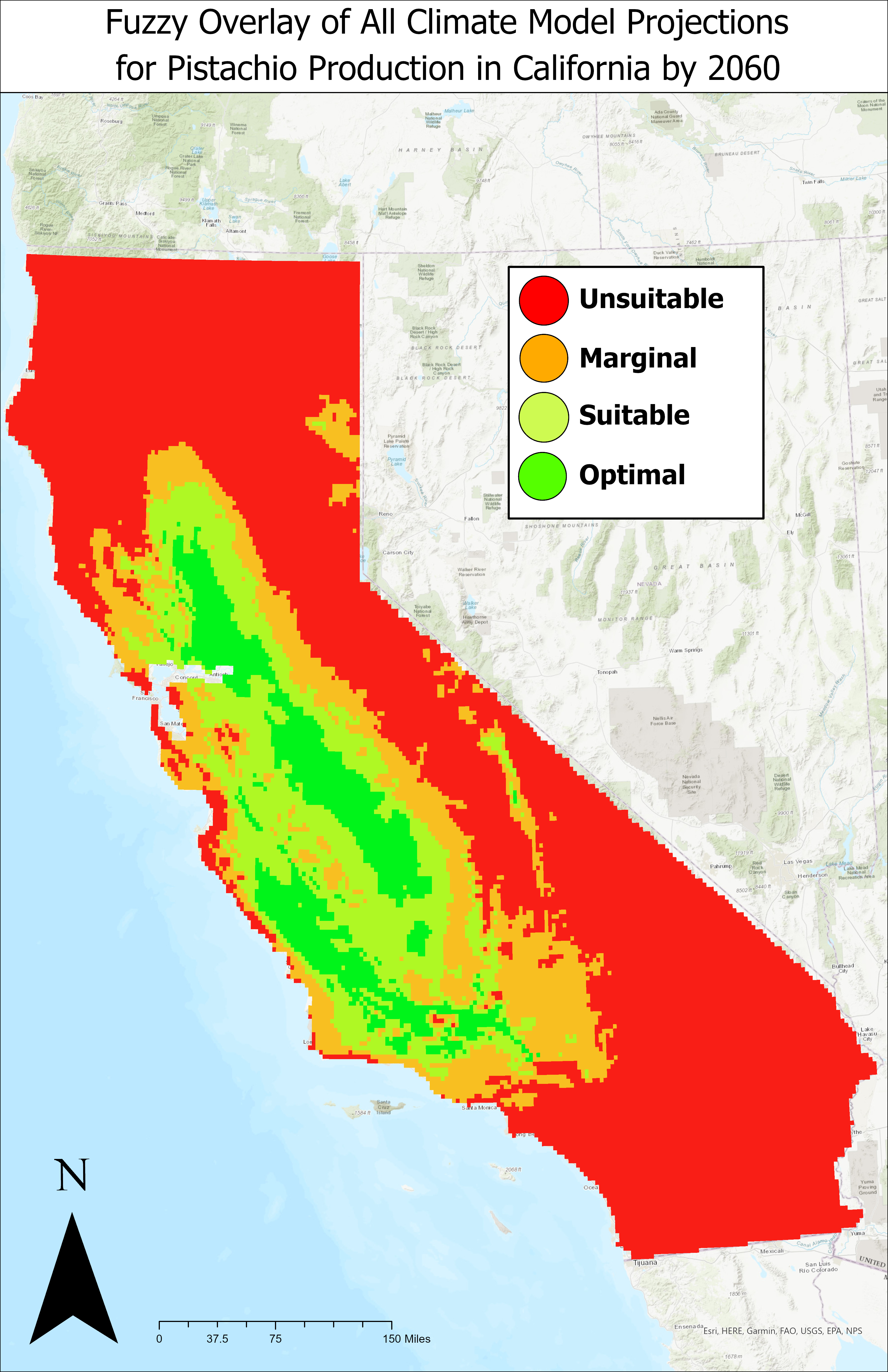
Figure 2. Displays the distribution of pistachio crops in California by the year 2061. We use four different GCMs that contain bioclimatic data on projected climate from the years 2041-2061. These GCMs all produced significantly different results in terms of expansion and contraction. To show the most likely areas of expansion and contraction we created a fuzzy overlay to obtain the averages based on the GCMs in the given timeframe. When we compare this map to our baseline reference (Figure 1), we can see that there is very little expansion expected in the near future. We are able to identify that most regions are expected to experience a contraction in suitability, especially throughout the central valley and Southern California.
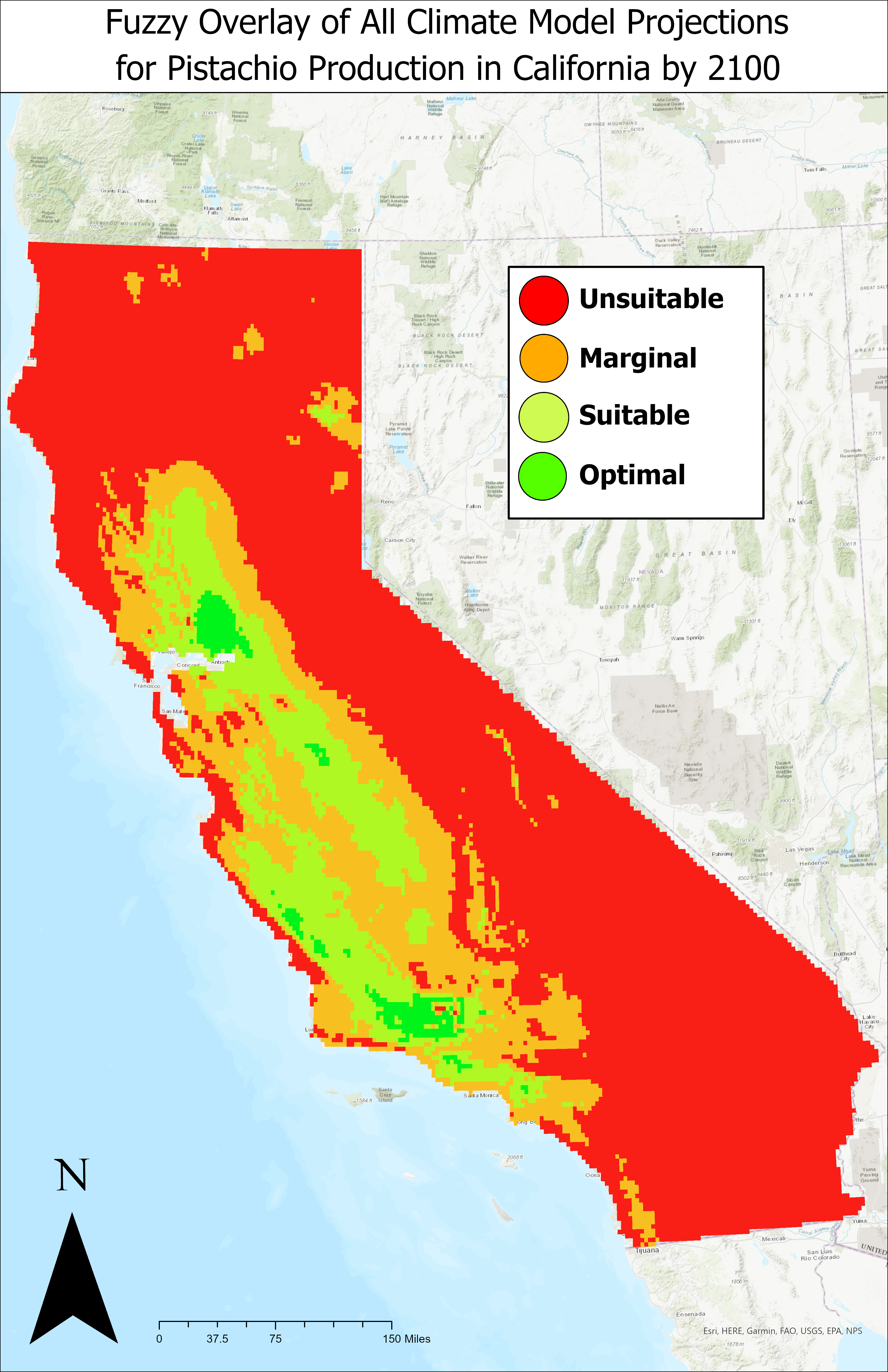
Figure 3. Displays the distribution of pistachio crops in California by the year 2100. We use four more GCMs that contain bioclimatic data on projected climate from the years 2081-2100. There were also some pretty significant differences between the different climate models; some showed more contraction than others. To obtain the averages of the models for the given timeframe we created a fuzzy overlay to represent the average predictions. When we compare these predictions to the baseline reference (Figure 1) or the previous prediction model (Figure 2), we can see that California will experience massive contraction throughout the state. Although we do see the revitalization of southern California’s pistachios toward the end of the 21st century.
4. Discussion
4.1 SDM Toolbox
At the beginning of this project, we were instructed to use the SDM toolbox, which was a downloadable extension for ArcGIS Pro and ArcMap. SDM stands for species distribution model and the toolbox contains a variety of tools, including a Max Ent tool that we wanted to use to perform our predictions. Unfortunately, the software for this extension hasn’t been updated and is no longer compatible with the current versions of Arc Pro and ArcMap.
4.2 Transition to python
Since we were unable to use the SDM toolbox, our group decided to search for alternative methods for running our predictions. For my contribution, I chose to create a python script using a Max Ent tool that is provided within ArcGIS Pro. The script took roughly two months to create and troubleshoot. After creating a working script we were able to obtain results that were similar to previous studies conducted by previous research students.
We ran into a few problems when setting up the Max Ent tool because we wanted to incorporate different climatic variables in the “features to predict” parameter. Any time we input climate data into this parameter we would get an “RuntimeError: Object: Error” so we were unsuccessful in utilizing this feature. However, we were successful in utilizing the “explanatory rasters matching” parameter which we were able to use to input future climate models. We ran the tool, incorporating one future GCM at a time in the “explanatory rasters matching” parameter, in order to obtain a total of eight different projection outputs.
4.3 Projected Movement
We expect to see pistachios moving away from the coast; the current distribution displays pistachios crops along the coastal regions but we expect to see these areas lose their sustainability in the near future. We also see a lot of the central valley losing the vast majority of their optimal farmland by 2100. Overall, we can see that pistachios are expected to have a severe decline in productivity throughout the state. The only region that is actually expected to experience growth is in small areas of Northern California. These regions are at a much higher elevation than the regions pistachios have traditionally been grown; this is most likely due to this region having cooler average temperatures that have risen to a marginally suitable temperature range as a result of the changing climate.
5. Conclusions and Future Work
This study will be continued to ensure that the results that we have are accurate. We would like to further analyze how pistachios are currently undergoing movement throughout California to provide more recent data and hopefully obtain different or similar results from the data that was used. Similar results would indicate that our projections are valid and should be taken into consideration when planting new pistachio crops. We are also in the process of calculating the change in suitable area which will allow us to see the amount of area lost. This will provide a better understanding about how much area in California is going to have to be converted to other land uses.
The main goal of this study is to provide insight into pistachio sustainability in order to inform farmers, policy makers, and landowners with the necessary information to make viable decisions about the cultivation of pistachios in response to the changing climate. It is clear that there is going to be a significantly different distribution of pistachio crops in the future. Adhering to the projections provided by this study would reduce the possibility of failed crops in the future.
It is also important to note that the United State Department of Agriculture should be prepared to find suitable locations for growing pistachio crops outside of California. The state will take an economic hit with the loss of productivity but the consumer needs will still need to be fulfilled. I believe it would be important to look at pistachio sustainability throughout the contiguous United States. This would provide valuable information for where pistachios should be moved to replace the deficiency introduced to the market.
Author Contributions
I, Dylan Russell, am the sole author of this research paper. The GIS analyses were performed by me over the course of a six month period. The research design was proposed by Dr. Gabriel Granco, who oversaw the research as a faculty advisor and provided the necessary datasets.
Additional Material
The python script used for this study can be found here. The bioclimatic data can be acquired through WorldClim.org.
References
Damaneh, Javad Momeni, et al. “Prediction of Wild Pistachio Ecological Niche Using Machine Learning Models.” Science Direct, Ecological Informatics, Dec. 2022, https://www-sciencedirect-com.proxy.library.cpp.edu/science/article/pii/S1574954122003570.
Derya, Aydin, et al. “Effect of High Temperature Events on Pistachio Growth and Development, Yield, and Quality.” International Journal of Plant Production, vol. 14, no. 2, 2020, pp. 169–180.
Fitzgibbon, Abigail, et al. “Evaluation of Maximum Entropy (Maxent) Machine Learning Model to Assess Relationships between Climate and Corn Suitability.” Land, vol. 11, no. 9, 2022, p. 1382., https://doi.org/10.3390/land11091382.
Gonzalez-Dugo, V., et al. “Improving the Precision of Irrigation in a Pistachio Farm Using an Unmanned Airborne Thermal System.” Irrigation Science, vol. 33, no. 1, 2014, pp. 43–52., https://doi.org/10.1007/s00271-014-0447-z.
Granco, Gabriel, et al. “Potential Effects of Climate Change on Brazil’s Land Use Policy for Renewable Energy from Sugarcane.” Resources, Conservation and Recycling, vol. 144, 2019, pp. 158–168., https://doi.org/10.1016/j.resconrec.2019.01.033.
Kerr, Amber, et al. “Vulnerability of California Specialty Crops to Projected Mid-Century Temperature Changes.” Climatic Change, vol. 148, no. 3, 2017, pp. 419–436., Sep 2017, https://doi.org/10.1007/s10584-017-2011-3.
Lu, B. “Water Use Efficiency and Growth of Pistachio (Pistacia Vera L.) under Deficit Irrigation and Waterlogging Stress.” Agricultural Water Management, vol. 218, 2019, pp. 33–43.
Ross, Karen. “CALIFORNIA AGRICULTURAL STATISTICS REVIEW 2019-2020.” California Department of Food and Agriculture, https://www.cdfa.ca.gov/Statistics/PDFs/2020_Ag_Stats_Review.pdf.
WorldClim. (n.d.). Retrieved April 23, 2023, from https://www.worldclim.org/data/cmip6/cmip6_clim30s.html
Yarahmadi, Jamshid, and Ata Amini. “Determining Land Suitability for Pistachio Cultivation Development Based on Climate Variables to Adapt to Drought.” Theoretical and Applied Climatology, vol. 143, no. 3-4, 2021, pp. 1631–1642., https://doi.org/10.1007/s00704-020-03499-4.
Zurell, Damaris, et al. “A Standard Protocol for Reporting Species Distribution Models.” Ecography, vol. 43, no. 9, 17 Jan. 2020, pp. 1261–1277., https://doi.org/10.1111/ecog.04960.